01
Store.
Use energy at the right time.
Plan battery dispatch around peak demand, charging opportunities, and the energy reserves the site needs to preserve.
BATTERY POWER + ENERGY
POWER ORCHESTRATION FOR CONSTRAINED SITES
A limited grid connection doesn’t have to limit every ambition. We’re building the coordination layer between your site’s power, storage, and flexible work.
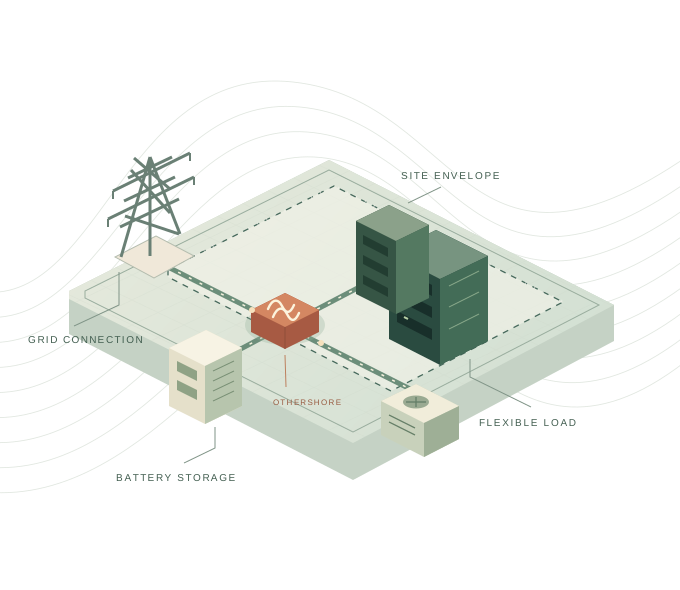
An illustrative dispatch moment. Storage support is temporary.
Move the work. Store the energy. Respect the limit.
01 / THE OPPORTUNITY
When power is the bottleneck, how the site operates matters as much as what it installs.
Grid upgrades take time. Batteries have finite energy. Workloads have commitments. Treating each in isolation leaves the operator to manage the tradeoffs.
Othershore starts with the whole site: a clear power boundary, the work that needs to happen, and the flexibility available to make it happen.
Explore the operating model02 / THE OPERATING MODEL
Three kinds of flexibility.
One shared envelope.
Plan battery dispatch around peak demand, charging opportunities, and the energy reserves the site needs to preserve.
Match deferrable compute or vehicle charging to available power, while keeping deadlines and service commitments explicit.
Bring cooling demand and thermal headroom into the site model, so electrical decisions account for their physical consequences.
Defined authority. Explicit reserves. Operator control.
THE ENVELOPE COMES FIRST03 / THE SITE EXPLORER
Try an illustrative site. Adjust the connection, requested demand, and battery energy to see where storage helps, and where work still needs to move.
Illustrative compute demand, including cooling. Battery discharge limit: 6 MW.
12 one-hour intervals · power in MW
The grid supplies demand up to the selected import limit. Storage supplies excess demand chronologically, within the scenario’s discharge limit and available energy. A 20% energy reserve is preserved. The model assumes ideal efficiency, no recharging, and that all unmet demand can be deferred. Each bar is a one-hour average. It does not model fast transients, protection, detailed thermal behavior, charging windows, or actual workload deadlines. The profiles are illustrative, not measured site data. This is an explanatory tool, not an engineering design, performance guarantee, or production controller. Temporary battery support does not increase firm grid capacity.
04 / WHERE WE’RE FOCUSED
Explore how deferrable inference and batch work could fit alongside storage and cooling within a constrained connection.
Coordinate energy needs, departure times, and site demand so charging flexibility has a clear operational purpose.
Model shared power across buildings, storage, and phased growth before committing to the next expansion.
05 / LET’S START SOMEWHERE REAL
A focused pilot starts with what you know: your connection, your flexible load, and an outcome worth testing.
The boundary is fixed.
The possibilities aren’t.